The development of the Mystara campaign setting represents a pivotal era in the history of tabletop role-playing games. It marks the transition from episodic dungeon exploration to the creation of a fully realized, geologically and politically consistent world.
Originally established as the default setting for the “Basic” line of Dungeons & Dragons during the 1980s, Mystara—often referred to as the Known World—distinguished itself through a unique blend of historical pastiche, high-magic fantasy, and a meritocratic system of divinity known as the Immortals. Unlike the grim realism of Greyhawk or the sprawling high fantasy of the Forgotten Realms, Mystara was designed with a meticulously calculated progression from a local adventurer to a world-shaping ruler and, ultimately, a cosmic deity.
Part I: The Genesis of a World
The Evolution from “Known World” to Mystara
The origins of Mystara are found not in corporate boardrooms, but in the private campaign of Lawrence Schick and Tom Moldvay, conducted between 1974 and 1976. This “Original Known World” (OKW) was envisioned as a shared fiction universe, inspired by the literary circles of H.P. Lovecraft, where various writers could contribute individual nations and cultures to a single continental map.
When TSR required a sample wilderness for the 1981 revision of the D&D Expert Set, Moldvay utilized this OKW foundation to create the map for module X1: The Isle of Dread. From those few hexes, a planet was born. However, it wasn’t until the BECMI (Basic, Expert, Companion, Master, Immortal) era that the setting solidified into the “lifestyle” game it is known as today.
The BECMI Lifecycle
Mystara established a “lifecycle” for characters that remains unique in the genre. Characters did not merely accumulate power; they transitioned through distinct tiers of societal influence:
| Boxed Set | Level Range | Narrative Focus |
| Basic Set | 1–3 | Local dungeon crawling and introductory mechanics. |
| Expert Set | 4–14 | Wilderness exploration and continental travel. |
| Companion Set | 15–25 | Domain Management and mass combat (War Machine). |
| Master Set | 26–36 | Regional empire management and the quest for immortality. |
| Immortal Set | 36+ | Cosmic play across the multiverse and the Spheres of Power. |
The best way to experience this entire progression is through the D&D Rules Cyclopedia, which compiles these rules into one legendary volume.
Part II: The Ancient Past – Blackmoor and the Great Rain of Fire
To understand Mystara, one must understand its scars. Approximately 4,000 years before the “present day” of the setting (AC 1000), Mystara was home to Blackmoor, a civilization of staggering technological and magical advancement.
The Technological Peak
Blackmoor was not a traditional fantasy setting. It featured nuclear reactors, medical nanotechnology, and “skyship” armadas. They drew their power from the Nucleus of the Spheres, a cosmic artifact that provided limitless energy but radiated a subtle, corrupting influence.
The Great Rain of Fire
The hubris of Blackmoor led to its literal downfall. In 3000 BC, a cataclysmic explosion of their high-tech devices—known as the Great Rain of Fire—shifted the planet’s axis and wiped out nearly all advanced life.
- The Axial Shift: The planet tilted, turning formerly tropical paradises into the frozen wastes now known as the Northern Reaches.
- The Fallout: The explosion released a magical radiation that caused widespread mutations, giving rise to many of the “monster” races found in the setting today.
Part III: A World Within a World
Mystara is not a standard planet. It is a hollow sphere, a design choice by the Immortals to facilitate a “planetary experiment.”
The Outer World
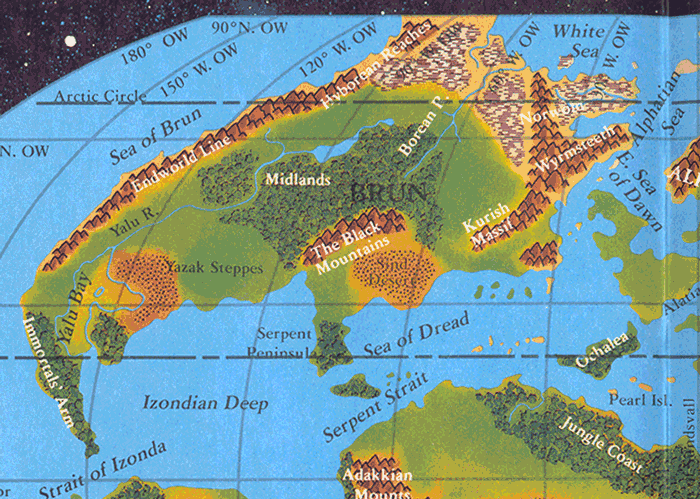
The surface consists of three major continents: Brun (the home of the Known World), Davania, and Skothar. The geography is modeled after Earth’s Laurasia and Gondwana from 135 million years ago, giving it a “prehistoric” feel where dinosaurs and mammoths are common sights.
The Hollow World: The Cultural Museum
The interior of Mystara is home to the Hollow World, a setting introduced in 1990.
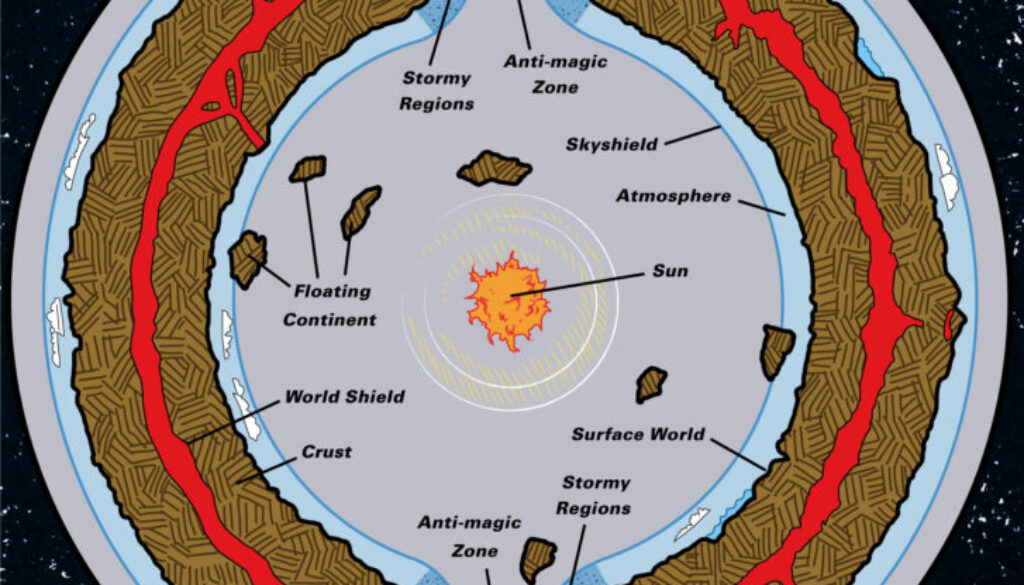
- The Red Sun: A tiny, eternal red sun sits at the planet’s core, providing constant light and warmth.
- The Preservation: Created by Ka the Preserver (an Immortal who began life as a dinosaur), the Hollow World acts as a “cultural museum.” When a civilization on the surface is about to go extinct, the Immortals “save” a portion of them by transplanting them inside.
- The Spell of Preservation: A powerful enchantment ensures these cultures—like the Nithians (Egyptians) and Azcans (Aztecs)—never change, advance in technology, or lose their identity.
The Moons: Matera and Patera
Mystara is orbited by two moons.
- Matera: A dead, rocky moon where the Immortals have their home city, Pandius.
- Patera: An invisible moon (hidden by magic) that houses Myoshima, a culture of feline Rakasta resembling feudal Japan.
Part IV: The Immortals and the Spheres of Power
Mystara is distinguished by the total absence of traditional gods. Instead, the multiverse is governed by the Immortals.
Ascension, Not Worship
In Mystara, anyone can become a “god.” Immortality is a rank achieved through merit, not birthright. To ascend, a level 36 character must find a sponsor and complete one of the four arduous Paths to Immortality (The Dynast, The Epic Hero, The Paragon, or The Polymath).
The Five Spheres
The universe is balanced between five fundamental forces:
- Matter (Earth): Focuses on law, stability, and physical structure.
- Energy (Fire): Focuses on magic, change, and activity.
- Time (Water): Focuses on continuity, history, and cycles.
- Thought (Air): Focuses on philosophy, knowledge, and the soul.
- Entropy (Void): Focuses on the eventual destruction and end of all things.
Part V: The Nations of Brun – A Cultural Tapestry
The primary continent of Mystara, Brun, is where most campaigns begin. The “Known World” is a relatively small corner of this continent, yet it contains enough political density to fuel decades of play.
The Grand Duchy of Karameikos (GAZ1): The Gothic Heart
Karameikos is the quintessential “Starter Setting.” It is a land of massive, dark forests and rugged mountains. The tension here is palpable: the ruling class are Thyatians who conquered the land thirty years ago, while the common folk are the Traladarans, a people steeped in Slavic folklore and superstition.
- The Hook: Players often start in the town of Threshold, a frontier settlement perfectly positioned for expeditions into the ruins of the ancient Traladaran kings.
- Atmosphere: Think of it as “D&D meets Ravenloft Lite.” It is a land of vampires, werewolves, and ancient family curses.
The Principalities of Glantri (GAZ3): Where Magic is Law
Glantri is perhaps the most unique nation in any fantasy setting. It is a Magocracy—a country ruled by an assembly of princes who are all high-level wizards.
- The Great School of Magic: Located in Glantri City (a city built on canals), this school is the Harvard of the magical world.
- The Anti-Cleric Law: In Glantri, practicing divine magic (clericism) is a capital offense. Clerics are hunted as subversive agents, making this a dangerous place for the party’s healer.
- The Secret Crafts: Glantrian wizards can specialize in “Secret Crafts” like Alchemy, Necromancy, or Great Dragon Magic, granting them powers far beyond standard spellcasting.
The Five Shires (GAZ8): The Hin at War
Do not mistake the “Hin” (halflings) of Mystara for the cozy, tea-drinking hobbits of Middle-earth. The Hin of the Five Shires are hardened survivors. They have spent centuries fighting off Orc invasions and human pirates. They utilize Blackflame, a mystical substance found in ancient crucibles, to craft glowing weapons and protect their borders.
The Shadow Elves (GAZ13): The Deepest Secret
While most D&D settings have Drow, Mystara has the Shadow Elves. These are not “evil” elves, but a tragic race forced underground after the Great Rain of Fire.
- The Skin of the Earth: They live in massive cavern systems beneath the Known World, worshipping the Immortal Rafiel.
- The Goal: Their entire culture is dedicated to returning to the surface and reclaiming their ancestral “Home,” which they believe is the Forest of Alfheim. This leads to one of the setting’s greatest conflicts: the eventual invasion and transformation of the elven surface homeland into a wasteland.
Part VI: The Savage Coast and the Red Curse
Located west of the Known World lies the Savage Coast, a 2,000-mile stretch of shoreline that feels like a blend of Pirates of the Caribbean and The Mutant Chronicles.
The Red Curse
The entire region is afflicted by the Red Curse, a magical “pollution” caused by the presence of Red Vermeil in the atmosphere.
- Legacies: The curse grants every inhabitant a “Legacy”—a spell-like ability (such as flight, fire-breathing, or telekinesis).
- The Cost: Using these powers, or even just staying in the region, causes physical and mental degeneration. Without protection, your character will eventually turn into a mindless, mutated monster.
- Cinnabryl: The only cure is a rare metal called Cinnabryl. This metal absorbs the curse but eventually turns into useless “Red Steel.” This creates a desperate, resource-driven economy where life is measured by the amount of metal you can wear.
A World of Red Steel
When Cinnabryl is exhausted, it becomes Red Steel, an alloy that is light as a feather but stronger than normal steel. It is the only material that can reliably harm the mutated horrors of the coast, making it the most sought-after treasure in the region.
👉 [Discover the grit and mutation of the Savage Coast / Red Steel on DriveThruRPG]
Part VII: Unique Mechanical Deep Dives
Mystara isn’t just a world; it’s a specific way of playing D&D. The Rules Cyclopedia introduced systems that addressed the “Fighter Problem” and the “Endgame Problem” long before modern editions.
Weapon Mastery: The Fighter’s Renaissance
In many older editions, a fighter just hits things. In Mystara, a fighter is a tactical genius. Weapon Mastery allows a character to progress from Basic to Grand Master in a specific weapon.
- Tactical Options: High-level masters unlock abilities like Despair (intimidating foes), Deflect (parrying incoming attacks), and Stun.
- Scaling Damage: A Grand Master with a simple dagger can deal damage equivalent to a heavy broadsword, making specialized builds incredibly viable.
The War Machine: High-Stakes Strategy
When you reach the Companion levels (15+), you are no longer just exploring dungeons; you are leading armies. The War Machine is a streamlined system for resolving mass battles.
- Battle Rating (BR): Every army has a score based on troop quality, leadership, and equipment.
- Strategic Depth: Instead of rolling for every soldier, the DM and players compare BR, modify for terrain and tactics, and resolve the entire battle in minutes. It turns the game into a grand strategy simulation without losing the RPG focus.
The Trial of the Immortals
As characters approach Level 36, the game shifts again. The “Master” rules provide frameworks for the Quest for Immortality. This isn’t just a level-up; it is a multi-year campaign arc involving:
- Locating a Sponsor: Finding an existing Immortal who will guide you.
- The Testimony: Proving your worth through a series of epic trials that often span the entire planet.
- Ascension: The character is retired as a mortal and becomes a new entity in the Immortal Set rules, shifting the game to a cosmic scale of Spheres and Multiverses.
Part VIII: The Creature Crucibles – Playing the “Monsters”
Long before Tasha’s Cauldron of Everything or modern “lineage” rules, Mystara broke the mold with the Creature Crucible series (PC1–PC4). These supplements allowed players to abandon the traditional races and play as the weird, wonderful, and terrifying denizens of the Known World.
PC1: Tall Tales of the Wee Folk
This book opened the door to the “Sylvan” races. Players could take on the roles of Dryads, Centaurs, Fauns, Leprechauns, and Sidhe. It introduced a unique “Hit Dice” leveling system, where a Dryad would grow in power and magical connection to her forest as she leveled up, rather than just gaining hit points.
PC2: Top Ballista
Perhaps the most “Gnome-tastic” book ever written, this focused on Serraine, a massive flying city inhabited by Gnomes, Nagpa, and Tabaxi. It introduced rules for Gnomish aeronautics and biplane dogfighting, pushing Mystara’s technology into a “da Vincipunk” territory that felt entirely distinct from the high-fantasy surface.
PC3: The Sea People & PC4: Night Howlers
- The Sea People: Detailed the underwater kingdoms of the Sunlit Sea, allowing for full campaigns featuring Merfolk, Tritons, and Sea Giants.
- Night Howlers: This was a game-changer for horror fans. It provided a system to play Lycanthropes (Werewolves, Werebears, etc.) as a character class. It tracked the “curse” not as a disease to be cured, but as a source of power that grew in complexity, including rules for shifting and managing your “animal” personality.
👉 [Browse the complete Creature Crucible (PC series) collection on DriveThruRPG]
Part IX: The Wrath of the Immortals – The End of an Era
In 1992, TSR published a boxed set that would change Mystara forever: The Wrath of the Immortals.
The Great War
The eternal cold war between the Empire of Thyatis and the Empire of Alphatia finally turned hot. Driven by the machinations of the Immortal of Entropy, Thanatos, the two superpowers engaged in a conflict that spanned years of in-game time.
- The Destruction of Alphatia: The war concluded with the entire continent of Alphatia—the land of ten thousand wizards—being physically sunk beneath the ocean by the Immortals.
- A Changed Map: Massive meteor strikes and magical fallout reshaped the Known World, turning lush regions into wastes and collapsing long-standing political alliances.
The Legacy of the Wrath
For many fans, this metaplot was controversial. It felt like the “end” of the classic, hopeful era of exploration. However, it provided a “Living World” feel that was revolutionary at the time. Today, many DMs choose to set their campaigns AC 1000 (pre-war) to enjoy the setting in its prime, while others use the Wrath as a blueprint for a high-stakes, apocalyptic campaign finale.
Part X: How to Play Mystara in 2026
If this guide has sparked a desire to explore the Hollow World or climb the ranks of Glantri, you are in luck. Mystara is experiencing a massive revival in the OSR (Old-School Renaissance) community.
The Buyer’s Guide
To run a successful Mystara campaign today, I recommend focusing on these “Pillar” products:
- The Bible: D&D Rules Cyclopedia. This is the only book you truly need. It contains everything from level 1 to 36, plus the world overview.
- The Adventure: B10: Night’s Dark Terror. The gold standard of wilderness sandbox design.
- The Setting: GAZ1: The Grand Duchy of Karameikos. This remains the best introduction to the “flavor” of the Known World.
Modern System Options
- Old-School Essentials (OSE): If you find the Rules Cyclopedia too dense, OSE provides a perfectly cleaned-up version of the B/X rules that is 100% compatible with Mystara modules.
- 5th Edition Conversions: While there is no “official” 5e Mystara book, the community-run Pandius.com (The Vault of Pandius) contains thousands of pages of fan-made conversions for every nation and monster.
Conclusion: Why Mystara Still Matters
Mystara remains a masterpiece of shared-world building because it never lost its sense of wonder and scale. It is a world where a Halfling can become a master of Blackflame, where a Wizard can rule a nation of canal-cities, and where any player—given enough grit and determination—can literally join the ranks of the gods.
It is a “Known World” that still has a million secrets left to find. Whether you are sailing the Savage Coast or exploring the red-lit jungles of the Hollow World, Mystara offers a depth of play that few settings have ever matched.
The Immortals are waiting. Will you begin your journey?